
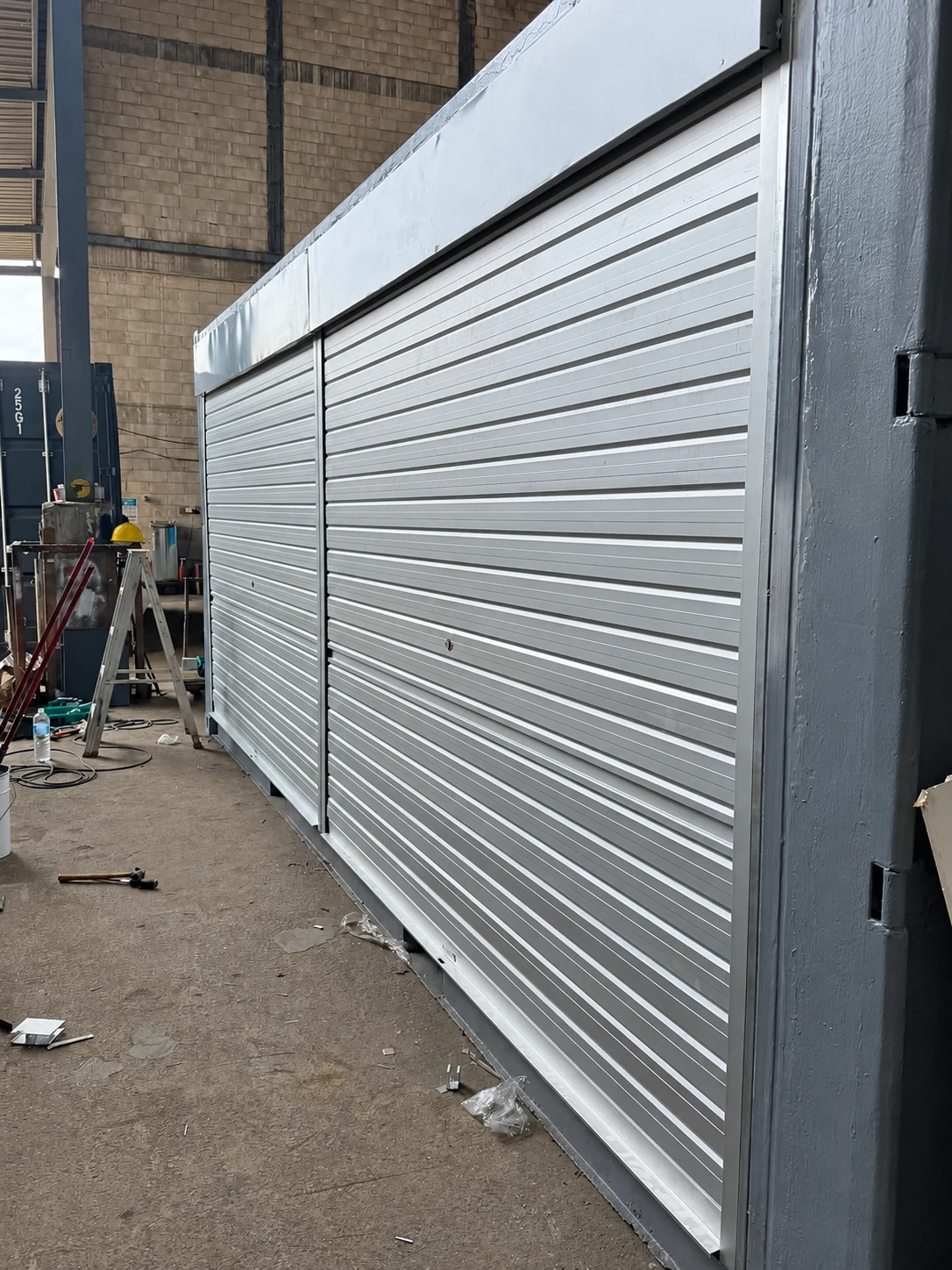
Use the visible layout to explain the problem
The guides are the vertical assemblies beside the curtain. You do not need to know their construction to identify the affected side. Take an overall photograph and describe left and right as seen from a stated position, such as “looking at the shutter from inside the shop”.
This small detail avoids confusion when messages are forwarded between a tenant, building manager and contractor. Include a photograph of any visible mark or deformation only where it is safe to do so. Avoid standing below a curtain that is uneven, hanging partly open or otherwise behaving unpredictably.
Describe alignment with reference points
Useful observations include a bottom edge that looks uneven, a curtain that sits differently at one side, or a scrape mark that was not previously present. Mention whether the symptom was first noticed after an impact or nearby building work. A photograph can record the present position without another operating attempt.
A sloping floor, camera angle or uneven surrounding finishes can make a picture difficult to interpret. Send an overall view rather than drawing a firm conclusion from one close-up. Do not use an apparent gap in a photograph as proof that a particular component has moved or failed.
Explain what happened during the last movement
If you already saw the shutter move before use was stopped, record whether the hesitation occurred in the same area or whether one side appeared to move differently. Note any scraping or knocking heard at the time. If you did not observe the movement, state that clearly.
For a motor shutter, record the control used and the visible response rather than repeatedly trying another control. For a manual system, describe the change in the effort you noticed. None of these observations should involve a fresh attempt to reproduce an unsafe or abnormal movement.
Why guide adjustment is not an owner check
Do not loosen the guide fixings, insert tools into the channel or try to pull the curtain towards the centre. The visible side of the opening is only part of the assembly. An adjustment made without understanding the system can also obscure the condition the contractor needs to inspect.
As general safety background, HSE’s powered-door basics supports maintenance by competent contractors. The relevant role for an owner or manager is to keep people clear, share the history and organise access, while the technical assessment is carried out for the actual shutter.
Ask for an assessment of the related parts
When you request roller shutter repair, ask the contractor to explain which areas need inspection and how the findings support the proposed work. A side-guide symptom may need consideration alongside the curtain and operating arrangement, rather than an assumption that the guide alone needs replacement.
Where there has been an impact, provide the incident history and ask whether the proposed scope addresses any related concerns. The Hörmann HR120 manual is an example of manufacturer-specific inspection instructions; the correct procedure must match the system on your site.
Make the quotation clear about the intended result
Ask the proposal to distinguish an assessment, an adjustment, replacement parts and any work on the surrounding installation. Clarify what is included in checking the operation after the work and what existing parts will remain. If some findings can only be confirmed after further access is arranged, have that uncertainty recorded.
For an occupied commercial unit, explain access times, nearby displays and loading movements. Identify the person who can agree variations if further damage is found. A precise scope is especially valuable where several people have described the same shutter as “off track”, each meaning something slightly different.
Keep a consistent record for future reports
After work is completed, keep the agreed scope and any operating information with the opening’s records. If the symptom returns, a dated photograph from the same safe viewpoint can help explain the change, without requiring another operating demonstration.
If there is also visible curtain damage, read the guide to damaged shutter slats before sending the enquiry. Focus on what can be seen, when it changed and which areas can be accessed safely. The purpose is to help the contractor assess the installation, not to perform alignment work yourself.