
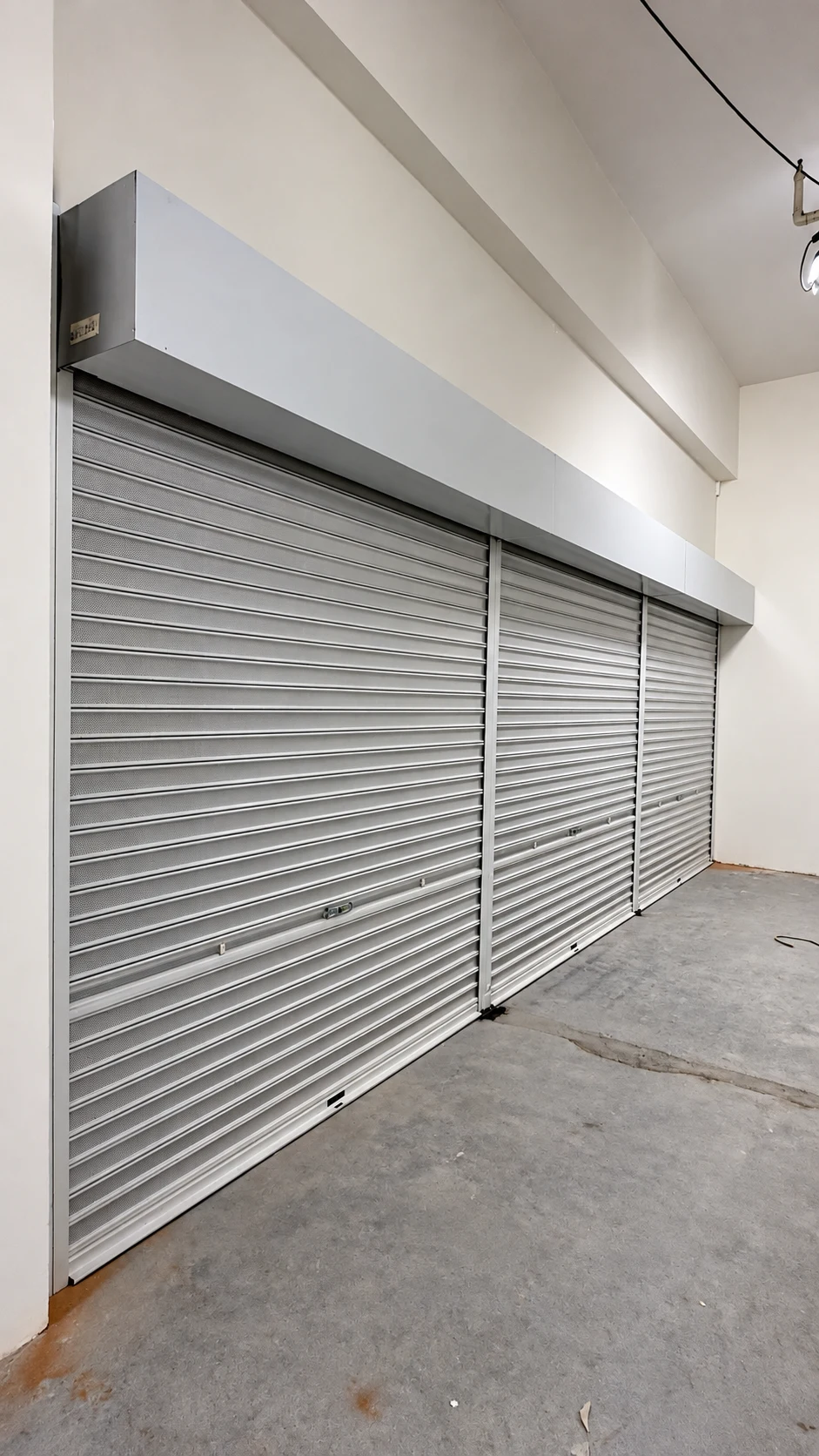
Compare the curtain rather than the name alone
A conventional solid roller shutter presents a largely continuous curtain of connected slats across the opening. A roller grille uses an open pattern, leaving visible spaces through the closure. Both descriptions concern the construction and appearance of the curtain; they do not establish a security rating or the suitability of a particular installation.
There are also shutter types between a completely solid curtain and an open grille. Perforated slats contain small openings, while some transparent shutters use clear panels. Ask which actual product is proposed rather than choosing on the basis of a generic quotation line such as “security shutter”.
Decide what should remain visible after closing
For a shop with a display facing a mall walkway, maintaining a view into the premises may be part of the brief. For a stockroom or workshop, concealing what is behind the opening may be more important. Write down the purpose before comparing photographs, because an attractive frontage image does not tell the supplier how you want the space to function.
Review the opening from both sides. Consider lighting, the position of displays and whether the rear of the shop should remain visible when staff have left. A grille’s open pattern and a solid curtain’s opaque surface create different views; the exact result depends on the selected design and the space behind it.
Check a sample or product drawing for the visual detail
Ask to see the actual pattern, material and finish being discussed. A grille may have a different spacing and profile from another grille, while a shutter’s slat shape and coating affect its appearance. Product illustrations are useful starting points, but colours, dimensions and component details should be confirmed in the proposal.
For manufacturer examples, Cornell’s security-grille range illustrates open-pattern products, while its service-door range describes solid rolling curtains. These examples help explain the categories; their model specifications are not a specification for A1’s products. Explore A1’s illustrated product range to frame your own enquiry.
Review the opening and operation separately
A choice of curtain does not settle whether an opening should be operated manually or by motor. The proposed dimensions, the installation around the opening and the way the premises uses it all need discussion. Provide approximate dimensions only if they are already known or can be obtained safely; the final installation is not determined from a photograph alone.
Explain who normally opens and closes the premises and how often the opening is used. Mention any space constraints at the sides or above it, without assuming that an existing box or guide can be reused. A1’s manual shutter and motor shutter pages provide starting points for these separate operation questions.
State performance requirements explicitly
If the project has a specified security, fire, environmental or other performance requirement, include the relevant project documents. An open pattern, heavy-looking curtain or dark finish is not evidence of a tested rating. The supplier needs to know what documentation or approval process the project actually requires.
Do not assume that a closure intended to show merchandise performs the same function as a solid external shutter or a fire-rated assembly. Equally, do not judge every product in a category by one example. Ask what is being proposed for this opening and which claims can be supported for that exact system, including its installation rather than the curtain in isolation.
Compare proposals using the same brief
Give each proposal the same opening information, view and privacy preferences, intended operation, finish requirements and site constraints. Then compare the stated product and scope rather than the appearance of unrelated catalogue photographs. Identify any exclusions, assumptions or items still awaiting a site assessment.
A useful short brief says what should be visible after closing, what the opening serves, how it is used and which project requirements are already documented. That gives a conversation about shutters or grilles a clear direction while leaving room to review the actual installation. Confirm availability and suitability directly with A1 before treating any illustrated option as the final selection.